Share this article
Precision from the Ground Up: Laser Land Leveling
Uniform water distribution is a primary requirement for high crop yields. However, most traditional fields have uneven surfaces, leading to waterlogging in some areas and dry patches in others. Laser Land Leveling (LLL) solves this using laser-guided grading.
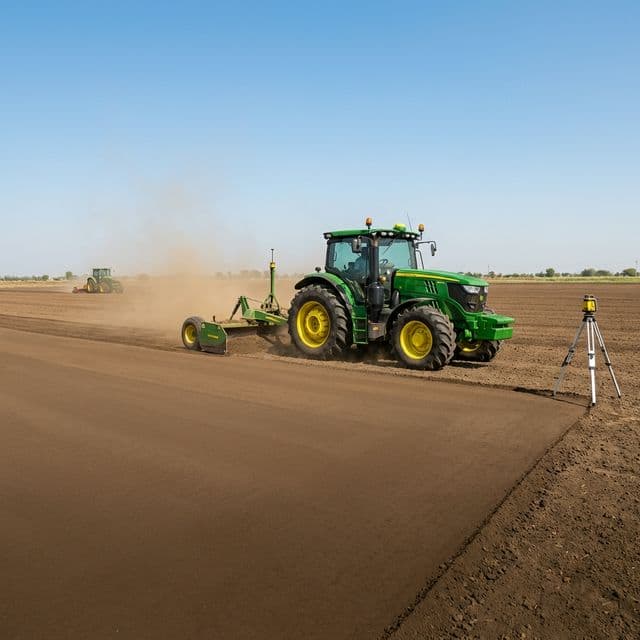
1. How the Technology Works A laser transmitter sends a beam across the field to a receiver mounted on a tractor-drawn scraper. The system automatically adjusts the blade to level the soil within a precision of 1-2 millimeters.
2. Major Benefits - Water Savings: Reduces irrigation time and water usage by 20-30%. - Uniform Maturity: Since water and nutrients are distributed evenly, the entire crop matures at the same time, making harvesting easier. - Weed Reduction: Even fields have fewer weed problems because there are no low spots for water to collect and weeds to sprout. - Increased Cultivable Area: Eliminates the need for many internal bunds and channels, increasing the effective field size by 2-5%.
3. Cost and ROI While hiring an LLL service costs more than traditional plowing, the savings in water, labor, and higher yields typically pay for the service in a single season.
Conclusion Laser land leveling is the first step towards truly "Smart" farming. By starting with a perfectly level field, you maximize the efficiency of every seed and drop of water you invest.
K
Written by KhetiSetu Agri-Expert
Agricultural expert and content creator dedicated to empowering farmers with knowledge and modern techniques.